|
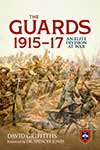
The Guards 1915-17
An Elite Division at War
By David Griffiths
|
This is the first of a two-volume history of The Guards Division, which was formed in August 1915 and disbanded just after the end of The First World War. Although Guards brigades had existed both before and after the war, a Guards Division only existed for that three-year period (1915-18) and again during the Second World War, the Guards Armoured Division (1942-45).
Views were mixed about the creation of the Guards Division in 1915. While Kitchener supported the idea, and sought The King’s permission without first consulting Sir John French beforehand, some members of the Guards thought it better to spread the Guards more evenly across the BEF. Others feared that if the Guards Division suffered heavily in a big action, then it would be much more difficult to reconstitute the Brigade of Guards.
The Guards Division had its baptism of fire at the Battle of Loos which began in September 1915, just a month after its formation. This was the battle that really does define all the worst characteristics of the First World War, and as this excellent book describes well, under the circumstances the Guards did as well as could be expected. The book provides a detailed operational history of the Guards Division, drawing on both official and personal accounts, painting a vivid description of the battles of 1915-17.
Was the Guards Division an elite formation as the title suggests? As the author concludes at the end of this slim volume, the Guards had a mixed record (like most divisions), in part because of all the constraints and factors that applied to all formations that fought in this war.
More importantly, perhaps, the Guards had a high reputation across the Army, their training and disciple was always of a particularly high standard, and in a tight spot, they were often more likely to ‘come through’ than some other formations. The best quote of all, which may well appear in the second volume of this study, says it all. Sometime after the war, The Prince of Wales (later King Edward VIII and the Duke of Windsor) wrote: ‘The Guards Division was a great club, and if tinged with snobbishness it was the snobbishness of tradition, discipline, perfection and sacrifice. They were the shock troops of the British Army; their prestige was purchased in blood’.
One small comment on this otherwise impressive study is that there is no index, which does seem an odd omission given the thorough footnoting and scholarship throughout the book.
The Editor
Published by Helion
|
|